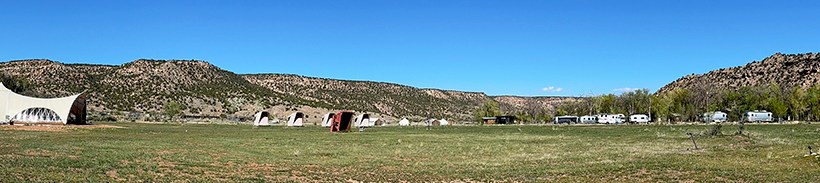

It’s the end of my first week at CampV in Naturita, Colorado, where I’ll spend a month as the artist-in-residence. I’m incredibly grateful for this opportunity; thank you, CampV! Being forced out of my routine is good medicine because it ramps up creativity and provides a break from everyday responsibilities and distractions.
Upon my arrival, my spring allergies went into hyperdrive. I spent my first week sneezing and blowing my nose nonstop. I’ve had some relief in the last few days and hope for continued improvement as the trees finish pollinating … and the trees! They are lime green with brand-new leaves and stunning when juxtaposed against red canyon walls. I’ll accept sneezing, itchy eyes, and snot in exchange for this visual bounty!
I spent a large portion of my first week pouring over maps, driving, hiking, and getting to know the lay of the land. I know little about this corner of Colorado and am also learning about the area’s history. I’ve taken lots of photos and have done some sketching and painting, albeit minimal, because it forces me to remain in one place for most of the day. I’m a big-picture girl and understand things best when I take in the whole and then dig into the parts and details. I’ve explored from the McPhee Reservoir in Dolores, CO, where a large portion of the Dolores River is held for agricultural and municipal use, all the way to where the Dolores leaves Colorado at the Utah border above Gateway, CO, plus multiple side roads and trails.
So far, I’ve only spent one day painting outdoors, which gave me new respect for en plein air painters, i.e., those who start and finish landscape paintings entirely outdoors. To put it mildly, it didn’t go smoothly for me, and the end result was pitiful. However, I learned a few critical things:
Lesson one: choose your location wisely; I chose mine poorly. As the day passed, my location became an Easy Bake Oven, creating misery. My dog and trusty sidekick, Ollie, kept trying to squeeze himself under the car, all 70 pounds of him. Yes, en plein air people, I had an umbrella but failed to use it correctly. I couldn’t point it in the right direction because the attachment was wrong. I asked the plein air gods to give me wisdom, but they laughed and let me bake, sweat, and squint for hours at a blinding canvas.
Lesson two: Paint dries ludicrously fast in a hot, dry climate, especially when adding Liquin or Galkyd. The gods got a kick out of how fast it became sticky and unmanageable and were probably as amused as watching a cat with tape stuck to its paws. The sticky paint was like moving glue over the surface rather than oil paint. My go-to faves for studio painting don’t work well in this climate.
Lesson three: The sun moves (duh!), so the entire value structure of my painting changed throughout the day. This endlessly perplexed me, and the gods laughed even more. Next time, I’ll quickly map out my value structure and stick with it. My rookie mistake was “correcting” my painting as the day went on. I’ve got to think differently out here.
Lesson four: Wind happens, especially in canyon country, because of the Easy Bake Oven Effect, which creates temperature variations that result in windy afternoons. This was tons of fun and sent my canvas flying into the silty, loose soil. However, my failure with the umbrella worked in my favor in this situation. If I’d attached it, my easel would be somewhere over eastern Colorado right now and listed as a U.A.P. or spying device of unknown origin. I spent lots of time holding things down and got paint everywhere! In addition to paint finding its way onto all the wrong surfaces, the desert also conspired against me. It inserted itself into my canvas, palette, supplies, lunch, eyes, and every crevice of my body, not to mention that Ollie is now tinted reddish-orange, as is my car.
The en plein air painting gods had a knee-slappin’ good time with this vulnerable, wimpy studio painter, a rookie at outdoor painting. I’m now convinced that the badasses of the art world are not abstract expressionists but rather en plein air painters. They deal with whatever gets thrown at them and laugh with the gods.
Next time, I’ll be more prepared. I suspect that going with the flow is critical to doing this well. In addition, I must choose my location wisely, adjust paint mediums to slow dry time, anchor things down or find a wind break, accept foreign objects in my paint, and use a stick-with-it mentality after establishing the initial composition. I’ll paint outdoors for the last half of my residency since my living quarters will be compact, so I have no choice but to figure this out. And who knows, after all of this, maybe I’ll join the ranks of the true badasses of the art world.
 Tammi Brazee